Why Screw Pile Foundations Make Sense in NSW
Screw pile foundations solve a lot of the headaches that come with building on typical NSW sites. Reactive clays in Western Sydney, sandy coastal blocks, steep sites across the Hills and Northern Beaches, and tight-access knockdowns in the Inner West all make traditional footings harder, slower, and more expensive than they first appear on the plans.
Instead of digging big holes, carting away spoil, and waiting for concrete to cure, screw piles are installed quickly with machinery most builders already have on site. For the right job, they offer a faster, cleaner, and more predictable footing solution compared with bored piers or strip footings, especially when ground conditions are less than friendly.
If you are a builder, tradie, designer, developer, or homeowner who wants fewer footing surprises, fewer variations, and better program certainty, understanding screw pile foundations is well worth your time.
What Screw Pile Foundations Actually Are
At its core, a screw pile is a steel foundation element that is literally screwed into the ground to carry the loads of your structure. Instead of relying on a big mass of concrete, it relies on steel strength and soil resistance along and under helical plates.
A typical screw pile system includes a central steel shaft (either pipe or solid bar) that takes the structural load, one or more helical plates welded near the toe that generate capacity as they screw into competent soil, and extension sections that allow the pile to go deeper where softer layers or fill are present. The pile is finished with head details or caps designed to connect to slabs, timber or steel subfloors, and structural steel columns.
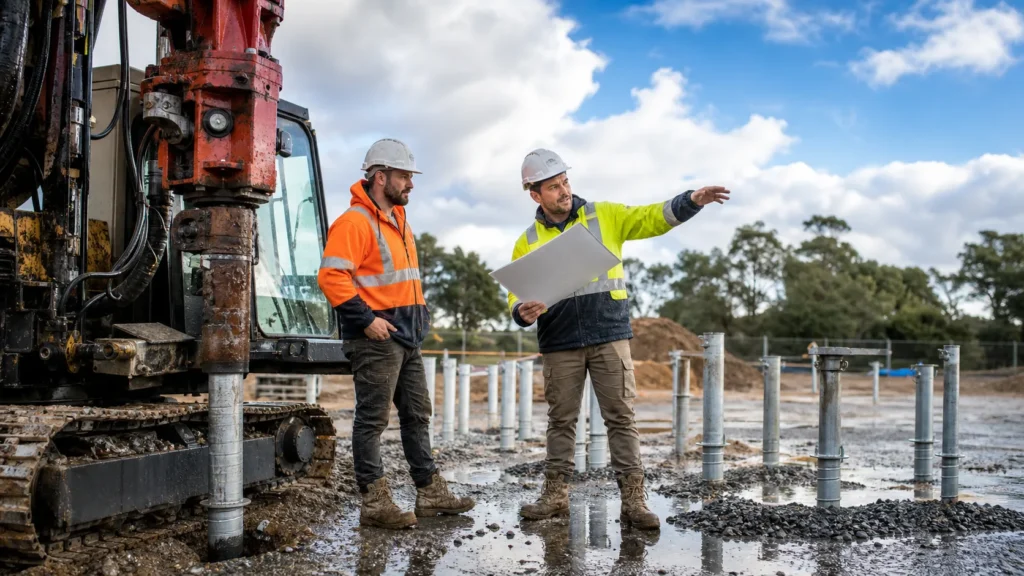
Installation is done with a hydraulic torque head mounted on an excavator or skid steer. As the pile screws into the ground, the installer monitors the torque in real time. Higher torque generally means the pile is engaging stronger soil and gaining capacity. We do not need to bury anyone in formulas on site, but installers and engineers use torque readings as a practical way to confirm each pile has achieved its design capacity.
It is important to distinguish fully engineered screw piles from light-duty temporary ground screws. Light ground screws might be fine for small garden structures, but structural foundations for houses, units, and commercial buildings rely on engineered screw piles, designed and certified as part of the building’s structure.
When properly designed, detailed on drawings, and signed off by a structural engineer in line with relevant Australian Standards, screw piles are an accepted and reliable footing system across residential, commercial, and civil projects.
When Screw Pile Foundations Beat Traditional Footings
Screw piles come into their own on the sort of ground conditions that cause variations with bored piers and strip footings. Common problem soils across Sydney and wider NSW include:
- Reactive clays that heave and shrink with moisture changes
- Uncontrolled fill that is inconsistent and full of surprises
- Alluvial soils near rivers and creeks that can be soft or saturated
- Sandy or collapsible coastal soils that do not behave well in open excavations
On these sites, screw piles often outperform traditional options because:
- They generate capacity at depth in better soil, past the troublesome surface layers
- There is far less spoil to remove compared with large pier or trench excavations
- Installation is less affected by high groundwater because there are no open holes to collapse or flood
- Machines are smaller and more agile, which suits back-of-block work and tight laneway access
There are also a few practical triggers that tend to push projects toward screw piles rather than conventional footings. These include wetter sites where pier holes keep collapsing, tight-access infill projects where drilling rigs and concrete trucks create major logistics issues, and sloping blocks where consistent founding levels are hard to achieve with strip footings. They are also commonly chosen where noise or vibration limits rule out driven piles or heavy rock breaking.
On a duplex in reactive clay, screw piles can avoid the cycle of over-excavation and concrete backfill that blows the footing budget. On a beachside renovation in loose sand, they can provide reliable support without trenches caving in. On an inner-city terrace extension with limited access, they can be installed from a compact machine where traditional gear simply cannot fit.
The on-site advantages add up:
- Less excavation and spoil removal
- No waiting days for concrete footing beams to cure before framing starts
- Cleaner, tidier work areas for other trades
- More predictable footing levels and reduced risk of last-minute design changes
How Screw Pile Design Works for Real Projects
Good screw pile design starts with understanding the ground. Geotechnical investigations or soil tests give the engineer information on soil types and layering (including fill, clays, sands, and rock), depth to competent founding material, and groundwater levels and any aggressive soil conditions.
From there, the engineer selects the shaft size and wall thickness to suit the loads and exposure, helix diameters and spacing to achieve the required capacity, expected pile depths (including allowances for softer zones), and the layout under walls, columns, edge beams, and slabs.
From a builder’s point of view, the process typically looks like this:
- Design brief and drawings are provided so the piling engineer understands loads and geometry
- A pile layout and specification are issued for approval
- Piles are set out on site, usually off survey or gridlines
- Installation proceeds with torque readings recorded for each pile
- Final logs and certificates are issued once installation and checks are complete
Different projects demand different capacities, so design is tailored to suit a wide range of applications, including lightweight timber-framed houses and decks, brick veneer or full masonry walls with higher point loads, portal frames and columns in warehouses or industrial units, and retaining walls, stairs, platforms, and access structures.
Depth is a common question on real jobs: what if refusal is hit early or piles need to go deeper than expected? Good design addresses this by building in contingency in pile length where soil conditions are uncertain, setting clear criteria for minimum and maximum depths, and agreeing upfront on rates or allowances for extensions so variations are transparent. This kind of planning helps manage cost and program risks linked to ground variability.
Installation Day on a NSW Job Site
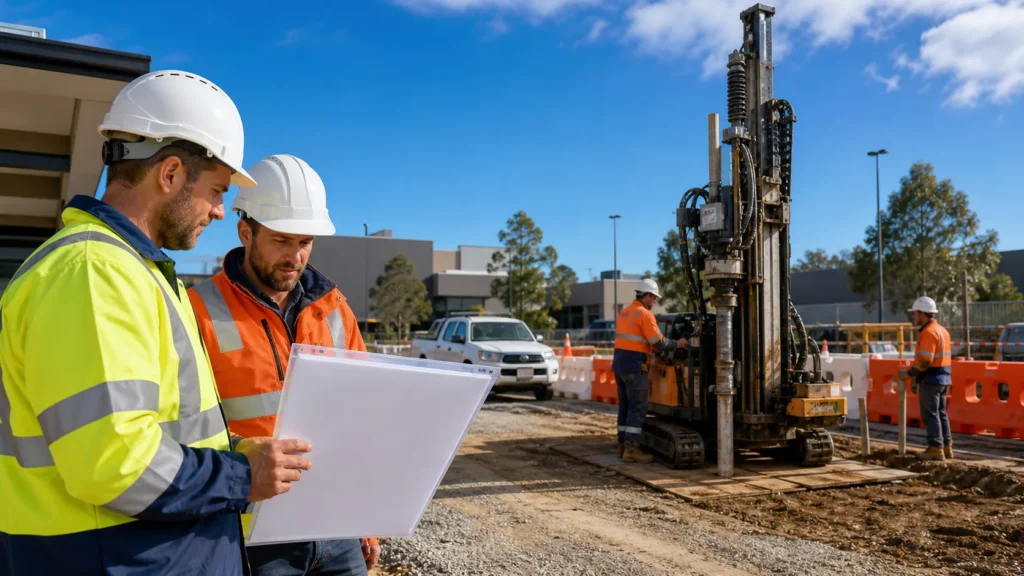
On site, a screw piling day is usually straightforward. Crews will:
- Confirm access, machine paths, and any low clearances or overhead services
- Mark out pile locations and check them against the drawings
- Set up the excavator or skid steer with the torque head and verify readings
- Install piles in a logical sequence to stay ahead of other trades
Once piles reach design torque and depth, they are cut to level or fitted with adjustable heads. They are then ready for:
- Slab thickening beams and reinforcement
- Bearers and joists for subfloor construction
- Baseplates for steel columns
In terms of timeframes, a typical Sydney house slab can often be piled in a short window, depending on pile numbers and access. Larger commercial jobs see higher production rates once the crew is set up and moving in flows.
Because there are no open excavations or fresh concrete footings, screw piling can usually keep going in light wet weather that would stop traditional footing works. That helps maintain programs through unsettled conditions.
Noise and vibration are generally far lower than driven piles. The main sound is the excavator engine and the torque head working, which is often more acceptable on tight infill sites near existing homes or strata buildings.
Quality checks on site include:
- Real-time torque monitoring on each pile
- Logging of depth, torque, and any changes in ground conditions encountered
- Adjustments to pile type or location if significant obstructions or unexpected soft layers are found
If an obstruction is hit, such as buried concrete or large rock, the installer and engineer will agree whether to relocate the pile, pre-drill, or change pile type so that structural intent is maintained.
Costs, Risks, and Common Misconceptions
Screw pile foundations are typically costed in one of three ways:
- Per pile, with a standard included length and rate for extensions
- Per linear metre of installed pile
- As a turnkey package that includes design, supply, installation, and certification
Even when unit rates look higher than concrete, the savings usually show up in reduced excavation and spoil removal, less time lost to weather delays and curing, and fewer surprises from footing blowouts and extra concrete.
There are a few misconceptions we often hear:
- That screw piles are only for big commercial jobs, when in reality they suit everything from decks and house slabs to multi-unit and civil works
- That they are always more expensive than concrete, which is rarely true once full site costs are compared
- That they are risky in coastal or aggressive soils, when in fact they can be detailed for durability with appropriate protective measures
Durability and corrosion protection are addressed through:
- Hot-dip galvanising where specified by design
- Additional coatings or sleeves in more aggressive exposure zones
- Design life considerations that match the expected life of the structure
For builders and owners, one of the biggest benefits is risk reduction. Practically, that means less chance of footing budgets blowing out once the ground is opened up, more predictable founding levels and set-out for follow-on trades, and clear engineering responsibility for the pile design and capacity.
Choosing Screw Pile Foundations for Your Next Build
Screw pile foundations are worth serious consideration whenever:
- Ground conditions are challenging or poorly understood
- Access is tight or constrained
- Programs are compressed and footing delays would hurt the schedule
- You want to reduce the risk of footing variations and rework
Bringing screw piles into the conversation early with engineers, builders, and designers helps ensure they are designed into the project properly rather than used as a last-minute fix when problems appear. Reviewing similar recent projects, getting geotech advice, and engaging an experienced screw piling contractor in NSW during pricing can all help make footing outcomes more predictable.
With the right design and installer, screw pile foundations can deliver faster, cleaner, and more reliable footing solutions across Sydney and wider NSW, for everything from new homes and extensions to commercial and civil projects.
Get Started With Your Project Today
If you are planning groundworks or a new build, we can help you assess whether screw pile foundations are the right choice for your site and soil conditions. At Screw Piling, we work closely with you to design a solution that suits your project, timescale and budget. Share your plans with us and we will provide clear guidance, transparent costs and a practical installation timeline to keep your project moving efficiently.
Can screw piles be installed next to existing footings?
Are screw piles common for renovations?
Do renovations still require engineering approval?
Yes. Existing structures increase compliance scrutiny.
Are screw piles faster for extensions?
Often, due to reduced excavation and curing time.